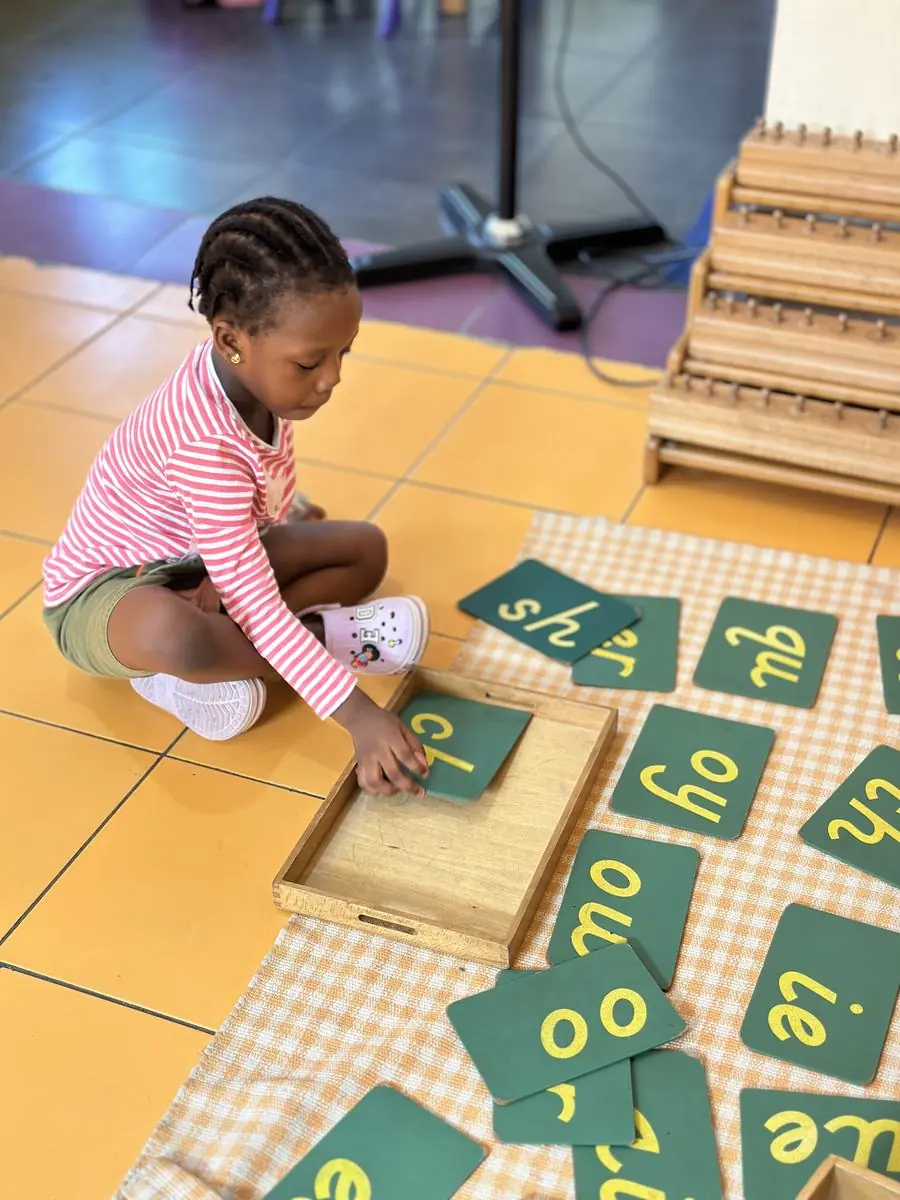
Choosing the right educational environment for your child is an important decision. With many schools adopting the Montessori name, it is essential to understand what an authentic Montessori programme looks like and what distinguishes it from other early childhood education approaches.
Montessori education is built on respect for the child, hands-on learning, independence and an understanding of how children develop. It provides an environment where children can explore, make choices, develop concentration and learn at their own pace with guidance from a trained Montessori adult.
Here are ten key features to look for when assessing an authentic Montessori programme.
A Prepared Environment
The Montessori classroom, often called the prepared environment, is intentionally designed around the needs and developmental stages of the child. Every element, from the furniture to the learning materials, supports independence, exploration and purposeful activity.
Look for an environment that includes:
- Child-sized furniture and equipment.
- Beautiful, orderly and uncluttered spaces.
- Clearly defined areas for different types of work.
- Learning materials displayed openly on low, accessible shelves.
- Freedom of movement within appropriate boundaries.
- A calm, welcoming atmosphere.
- Access to outdoor spaces where possible.
- Real-life objects that children can use independently.
The environment should communicate a simple but powerful message to every child:
You belong here. You are capable. You can do things for yourself.
Authentic Montessori Materials
Montessori materials are carefully designed to help children understand concepts through hands-on exploration and repeated practice. Rather than relying primarily on worksheets or memorisation, children engage with concrete materials that support learning, discovery and the gradual development of abstract thinking.
The materials vary according to the children’s ages and developmental needs and are typically organised into the following curriculum areas.
Practical Life
Practical Life activities help children develop independence, coordination, concentration and care for themselves and their environment.
Examples include:
- Pouring and transferring.
- Washing and cleaning.
- Using dressing frames.
- Preparing food.
- Caring for themselves and their surroundings.
Sensorial
Sensorial materials help children refine their senses, recognise patterns and distinguish differences in size, shape, colour, texture and dimension.
Examples include:
- Pink Tower.
- Brown Stair.
- Red Rods.
- Knobbed Cylinders.
- Colour Tablets.
- Geometric materials.
Language
Language materials support vocabulary development, sound recognition, writing and reading.
Examples include:
- Sandpaper Letters.
- Moveable Alphabet.
- Metal Insets.
- Classified cards.
- Reading materials.
Mathematics
Montessori mathematics materials introduce numerical concepts through concrete experiences before progressing towards more abstract understanding.
Examples include:
- Number Rods.
- Sandpaper Numerals.
- Spindle Box.
- Golden Bead Material.
- Decimal System materials.
- Bead chains.
- Stamp Game.
Cultural Studies
Cultural activities introduce children to the wider world and encourage curiosity about their surroundings, nature and human society.
These may include geography, biology, science, history, art and music.
An authentic Montessori programme uses these materials purposefully. Their presence alone is not enough; children should be introduced to them appropriately and given opportunities to work with them independently as their skills develop.
A Trained Montessori Adult
The Montessori adult, often called a guide, is one of the most important elements of the classroom. Their role goes beyond delivering lessons. They prepare the environment, observe each child and guide the child’s relationship with the learning materials.
An effective Montessori guide:
- Observes children carefully and understands their developmental needs.
- Presents materials accurately and deliberately.
- Protects children’s concentration.
- Intervenes when necessary without taking over.
- Maintains the prepared environment.
- Builds respectful relationships with each child.
- Recognises individual readiness rather than forcing every child to follow the same timetable.
The adult’s responsibility is to create the conditions in which children can learn and grow. Rather than directing every moment of the day, the guide supports children as they become increasingly independent, confident and capable.
When evaluating a Montessori programme, ask about the training, qualifications and experience of the adults working directly with the children.
A Mixed-Age Community
Authentic Montessori classrooms generally bring children of different ages together within carefully planned developmental groupings.
Common Montessori environments include:
- Nido: An environment for infants.
- Toddler Community: Typically for children around 18 months to 3 years.
- Children’s House: Typically for children around 3 to 6 years.
The exact age ranges may vary slightly between programmes.
Mixed-age classrooms create opportunities for children to learn from one another. Younger children observe older peers demonstrating skills and engaging with materials, while older children reinforce their knowledge by helping others and taking on greater responsibility.
This community structure also supports social development, cooperation, patience and a sense of belonging. Children are not constantly compared with peers of exactly the same age, allowing room for individual progress.
Freedom Within Limits
Freedom is a central principle of Montessori education, but it does not mean allowing children to do anything they want without guidance.
Within clear and respectful boundaries, children have meaningful choices about what to work with, where to work, when to work and whether to work independently or with others.
This freedom exists alongside responsibility. Children are expected to care for classroom materials, respect other people’s work, restore materials to their proper places and contribute positively to the community.
For example, a child may choose to work with the Pink Tower rather than a language activity, provided the material is available and the child has been introduced to it appropriately.
Through these experiences, children learn decision-making, self-regulation and respect for others. They gradually understand that freedom and responsibility belong together.
Long, Uninterrupted Work Periods
Children need time to become deeply engaged in their work. An authentic Montessori programme therefore protects substantial periods of uninterrupted activity, often referred to as the Montessori work cycle.
Rather than repeatedly stopping children for whole-group lessons, transitions and unrelated activities, the classroom schedule allows children to choose work, practise skills and develop concentration.
During this period, a child may follow a natural learning process:
- Choose
- Concentrate
- Practise
- Make mistakes
- Self-correct
- Develop mastery
- Repeat
This process allows children to work at their own pace, revisit activities and develop persistence. It also gives the Montessori guide time to observe individual progress and introduce new lessons when children are ready.
When visiting a school, ask how the daily schedule protects children’s independent work time and how frequently their concentration is interrupted.
Respect for the Child
Respect is not simply something Montessori adults talk about. It should be visible in their everyday interactions with children.
In a Montessori environment, adults aim to:
- Speak to children respectfully.
- Give children time to respond and express themselves.
- Avoid unnecessarily interrupting concentration.
- Encourage independence instead of doing everything for the child.
- Use guidance rather than relying on punishment or excessive praise.
- Establish firm but respectful boundaries.
- Recognise each child’s individual developmental journey.
Respect also means acknowledging that children are capable of meaningful participation in their own learning. Adults provide guidance and support while allowing children opportunities to try, make mistakes and learn from experience.
A respectful classroom does not mean a classroom without boundaries. It means that boundaries are established consistently and communicated in ways that preserve the child’s dignity.
Observation and Individualised Progress
Montessori education recognises that children do not all develop the same skills at the same time. Observation helps the Montessori guide understand each child’s interests, abilities, challenges and readiness for new learning experiences.
The guide may observe:
- Interests and preferred activities.
- Developmental readiness.
- Concentration and persistence.
- Movement and coordination.
- Language development.
- Social interactions.
- Independence and self-care.
- Areas where additional support may be needed.
These observations inform decisions about which lessons to introduce, which materials to make available and when to offer further challenges.
Rather than expecting every child to master the same skill according to a fixed weekly scheme of work, the guide responds to individual progress while ensuring that children receive appropriate opportunities across the curriculum.
Parents should be able to ask how the school observes, documents and communicates each child’s development.
Real Responsibility
Children in a Montessori classroom are active members of their community. They are given meaningful opportunities to contribute to the daily life of the environment.
Depending on their age and abilities, children may:
- Sweep floors and mop small spills.
- Water plants.
- Prepare simple foods.
- Wash tables.
- Arrange flowers.
- Care for animals where appropriate.
- Return materials to their shelves.
- Serve themselves during meals.
- Help younger children when appropriate.
These are not simply activities designed to keep children busy. They provide practical opportunities to develop coordination, concentration, planning, problem-solving and independence.
When children are trusted with real responsibilities, they begin to understand that their actions matter. They learn to care for their surroundings, contribute to a community and take pride in what they can accomplish.
The goal is not perfection. It is to give children repeated opportunities to practise useful skills and become more capable over time.
Beauty, Order and Purpose
A Montessori environment is typically calm, orderly, functional and thoughtfully arranged. The classroom should be visually appealing without being overwhelming, with materials carefully maintained and accessible to the children who use them.
Look for an environment that is:
- Beautiful and welcoming.
- Natural and calm in its presentation.
- Organised and uncluttered.
- Functional and suited to children’s needs.
- Carefully maintained.
- Arranged so that everything has a purpose and a place.
Order helps children understand their surroundings and find what they need independently. A thoughtfully prepared space can also support concentration, movement and a sense of security.
Importantly, beauty in Montessori education is not about expensive furniture, elaborate decorations or impressive classroom displays. It is about creating a space that reflects care, intention and respect for the child.
How Can Parents Identify an Authentic Montessori Programme?
When visiting a school, look beyond its name, website or classroom decorations. Pay attention to what happens during an ordinary school day.
Observe whether children can access materials independently, whether adults allow them time to concentrate, whether the classroom is organised around children’s needs and whether the learning experiences encourage independence and purposeful activity.
You can also ask the school about its Montessori training, classroom groupings, daily work cycle, learning materials and approach to observing individual development.
Most importantly, look for consistency. Authentic Montessori education is not defined by one piece of equipment or a single teaching technique. It is reflected in the way the environment, adult, materials and daily routines work together to support the development of the whole child.
Final Thoughts
An authentic Montessori programme offers more than a collection of educational materials or a particular classroom arrangement. It provides a carefully prepared environment where children are respected as capable learners and supported as they develop independence, concentration, confidence and responsibility.
By understanding these ten key features, parents can make more informed decisions about their children’s education and identify environments that reflect the principles of Montessori.
The most important question is not simply whether a school calls itself Montessori, but whether its everyday practices genuinely reflect the Montessori approach to learning and child development.
Visit our prepared environment
Tours run on Tuesdays and Thursdays in small, unhurried sessions so your questions get real answers.
Or speak with admissions directly on +234 708 186 4078